Workplace Investigation Resources
How Long Does a Workplace Investigation Take?
Every workplace investigation is different. While some can be completed within days, others require several weeks to ensure the evidence is gathered fairly, thoroughly and objectively.
One of the first questions organisations ask after an allegation has been received is, “How long will the investigation take?” It is a reasonable question, particularly where employees, managers and organisational operations may be affected while enquiries are underway.
The reality is that there is no standard timeframe. The duration of an investigation depends on the complexity of the allegation, the amount of available evidence, the number of witnesses, document review requirements and whether additional enquiries become necessary as the investigation progresses.
A professional investigation should always balance efficiency with procedural fairness. Completing an investigation quickly is valuable—but only if the findings remain thorough, objective and capable of supporting confident organisational decision-making.

There Is No Standard Investigation Timeframe
Unlike statutory legal processes, workplace investigations are not governed by a fixed number of days. Instead, investigators are expected to conduct enquiries that are proportionate to the issues being examined while ensuring procedural fairness for everyone involved.
A relatively straightforward matter involving one allegation, limited documentation and only a small number of witnesses may be completed within several days. More complex investigations involving multiple interviews, extensive evidence review, CCTV analysis or technical information naturally require more time.
Experienced investigators avoid setting unrealistic deadlines before understanding the scope of the investigation. As evidence is gathered, the picture often becomes clearer and additional enquiries may become necessary to ensure findings remain balanced, evidence-based and defensible.
For organisations, this means that a carefully managed investigation often provides greater long-term value than one completed simply to meet an arbitrary deadline.
━━━━━━━━
TYPICAL TIMEFRAMES
Complexity, not urgency alone, determines how long an investigation takes
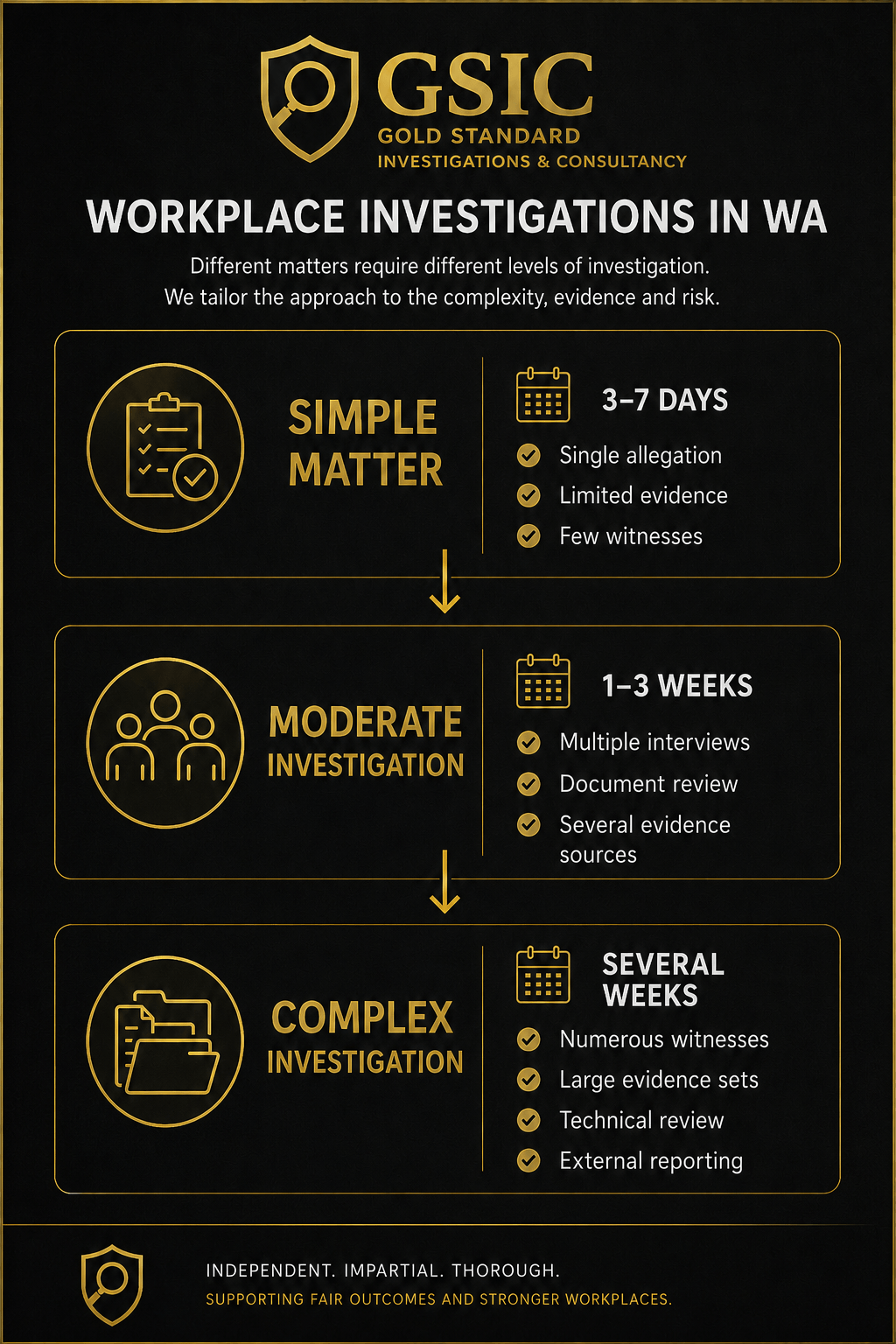
Investigation timeframes depend on the scope of the matter and the work required to reach reliable findings. A simple allegation supported by limited evidence may be resolved quickly, while a complex investigation involving multiple witnesses and large evidence sets will naturally take longer.
- Simple matters may take approximately 3–7 days.
- Moderate investigations may take approximately 1–3 weeks.
- Complex investigations may require several weeks.
These are practical indications rather than fixed deadlines. Witness availability, FIFO rosters, document volume and new evidence can all influence the final timeframe.
Select the infographic to open the full-size version in a new tab.
What Influences Investigation Length?
Every investigation begins with an agreed scope, but very few follow an identical path. Several practical factors influence how long enquiries are likely to take.
- The seriousness and complexity of the allegation.
- The number of employees requiring interview.
- The availability of witnesses, particularly across multiple sites or FIFO rosters.
- The volume of documents requiring review.
- Whether CCTV or digital evidence requires analysis.
- The need for specialist technical advice.
- Additional issues identified during evidence gathering.
- Maintaining procedural fairness throughout the investigation.
Rather than delaying the investigation unnecessarily, these factors help ensure that all relevant evidence is considered before findings are finalised.
Why Investigations Sometimes Take Longer Than Expected
One of the most common concerns organisations have is when an investigation takes longer than originally anticipated. In reality, this often reflects a thorough and professionally managed investigation rather than unnecessary delay.
As enquiries progress, investigators frequently receive additional information requiring further examination. New witnesses may be identified, further documentation may become available or interview responses may require clarification before balanced findings can be reached.
Practical considerations also influence investigation timescales. Employees may be working FIFO rosters, be on annual leave or unavailable due to operational commitments. CCTV footage may require detailed review and evidence from multiple locations may need to be gathered before interviews can be completed.
These additional enquiries are not signs that an investigation has lost direction. They demonstrate that evidence is being tested objectively rather than assumptions being accepted without proper examination.
A carefully managed investigation seeks to establish the facts completely, even if that requires slightly more time. The quality of the outcome is considerably more important than meeting an arbitrary deadline.
Good investigations aren’t measured by how quickly they finish.
They’re measured by how confidently decisions can be made.
What Happens During a Workplace Investigation?
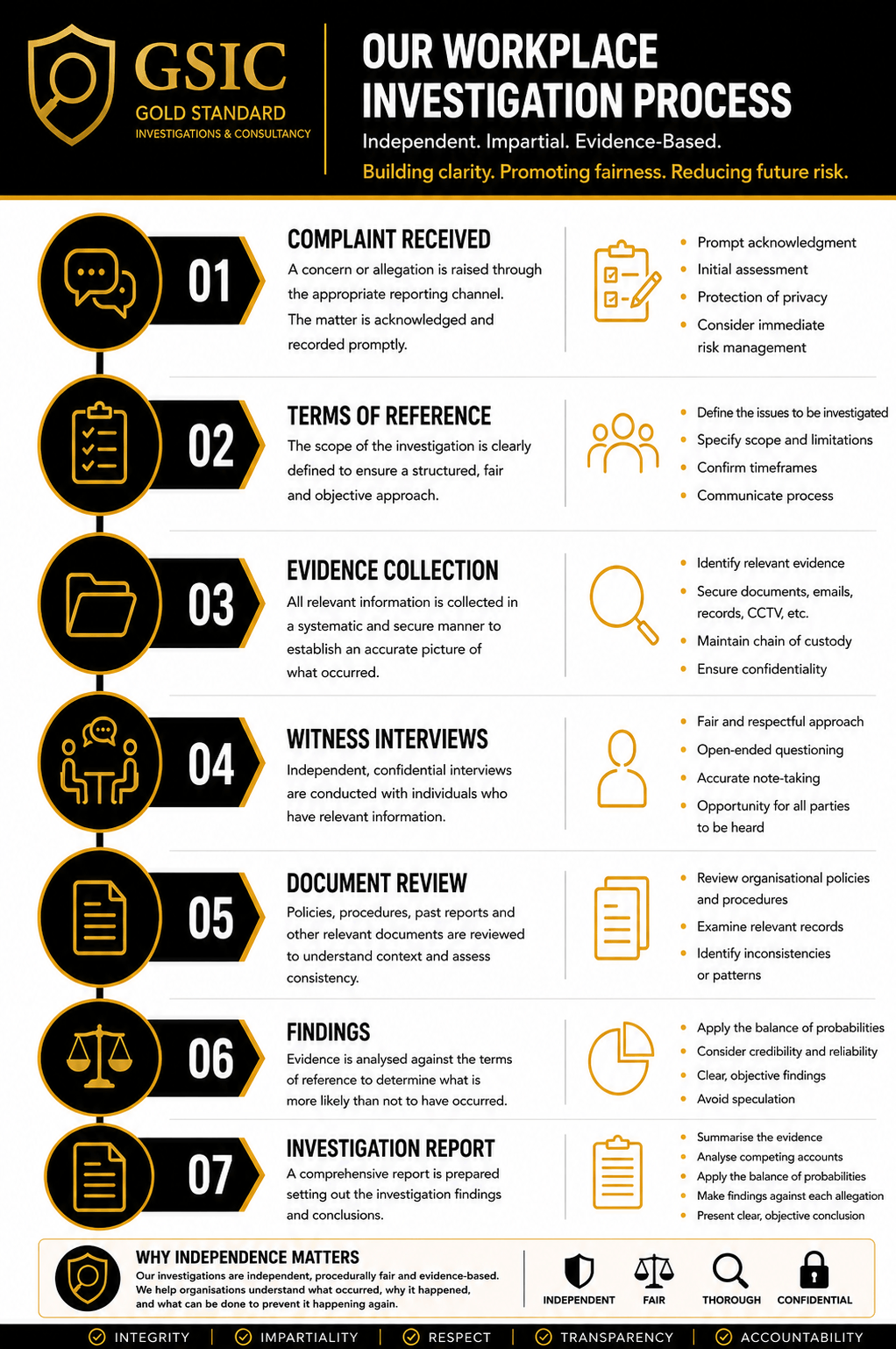
Although every investigation differs, professional workplace investigations generally follow a structured methodology designed to ensure evidence is gathered consistently and procedural fairness is maintained throughout.
The process usually begins by establishing clear Terms of Reference which define exactly what is being investigated. Evidence is then gathered through interviews, documentation, CCTV review where appropriate and examination of relevant organisational records.
Rather than reaching immediate conclusions, investigators assess all available information before determining whether the evidence supports particular findings.
This structured approach ensures investigations remain objective, transparent and capable of withstanding scrutiny should decisions later be challenged.
Select the infographic to open the full-size version in a new tab.
Why Faster Isn’t Always Better
There can be understandable pressure to conclude investigations quickly, particularly where employees remain uncertain or operational decisions are waiting for an outcome. However, speed should never come at the expense of accuracy, fairness or evidence quality.
Experienced investigators test information rather than accepting the first explanation they receive. Interviews may need to be revisited, conflicting evidence reconciled and documentation reviewed carefully before reliable conclusions can be reached.
Equally important is ensuring everyone involved has a fair opportunity to provide information, respond to relevant allegations and have their evidence considered objectively. Rushed investigations increase the likelihood of overlooking important information or making decisions based upon incomplete evidence.
The objective is therefore not to produce the fastest report. It is to produce findings that decision-makers can rely upon with confidence.
Keeping Everyone Informed During the Investigation
While investigators cannot disclose confidential evidence as enquiries progress, organisations should keep relevant employees appropriately informed about the investigation process wherever possible.
Providing realistic expectations regarding likely timeframes, explaining the stages of the investigation and advising when updates can reasonably be expected helps reduce uncertainty and maintains confidence in the process.
Clear communication also demonstrates procedural fairness. Employees should understand that investigations are being progressed diligently, even where complex evidence or operational commitments mean the investigation cannot be completed immediately.
Professional investigators therefore balance confidentiality with transparency, ensuring organisations remain informed without compromising the integrity of the investigation itself.

Different Workplaces Present Different Challenges
The environment in which an investigation takes place can significantly influence both its complexity and its duration. Organisations operating across multiple sites, regional locations or complex operational environments often require additional planning before evidence can be gathered effectively.
Mining operations may involve FIFO rosters, remote accommodation, contractor workforces and employees spread across large operational areas. Local government investigations may involve elected members, community interactions and multiple operational departments. Corporate organisations often require extensive document review, policy assessment and interviews across several business functions.
These differences do not necessarily make investigations more difficult. They simply reinforce why experienced investigators avoid applying identical timeframes to every matter. Each investigation should be planned according to its own circumstances, evidence and organisational context.
Regardless of industry, organisations benefit from investigations that are proportionate, professionally managed and capable of producing findings that can be relied upon with confidence.
Thorough investigations protect organisations.
Fair investigations protect people.
Frequently Asked Questions
How long does a straightforward workplace investigation usually take?
Simple investigations involving one allegation, limited evidence and only a small number of witnesses are often completed within several days. More complex matters naturally require additional time.
Why do investigations sometimes take longer than expected?
Additional witnesses, document reviews, CCTV analysis, employee availability and new evidence identified during enquiries may all extend the investigation while ensuring findings remain accurate and procedurally fair.
Should employees receive updates during an investigation?
Yes. While confidential evidence cannot usually be discussed, organisations should provide appropriate updates regarding progress, expected timeframes and the investigation process where possible.
Can new allegations extend an investigation?
Yes. Where credible new information is identified, investigators may need to expand enquiries to ensure all relevant evidence is properly assessed before findings are finalised.
Does every workplace investigation involve interviews?
Most investigations involve some form of interview, although the number of people interviewed depends entirely on the issues being examined and the available evidence.
Is there a legal deadline for workplace investigations?
There is generally no fixed legal timeframe. Investigations should instead be completed as promptly as reasonably possible while ensuring procedural fairness and appropriate consideration of all relevant evidence.
Need an Independent Workplace Investigation?
GSIC conducts independent workplace investigations across mining, local government, corporate and public sector organisations throughout Australia. Every investigation is conducted objectively, professionally and with procedural fairness at its core.
Whether you are responding to allegations of misconduct, behavioural concerns, integrity matters or psychosocial issues, we provide balanced findings that support informed organisational decision-making. Where appropriate to the agreed scope, separate advice may also help identify opportunities to reduce future organisational risk.